In 2026, four frameworks dominate web application development: Astro, Vue.js, React, and Next.js. Each has its strengths and typical use cases — the right choice translates directly into performance, maintenance cost, and development speed.
This is not a ranking of “the best.” It is a practical comparison: what to pick for a company website, a web application, or an e-commerce store — with benchmarks and concrete recommendations.
Quick comparison
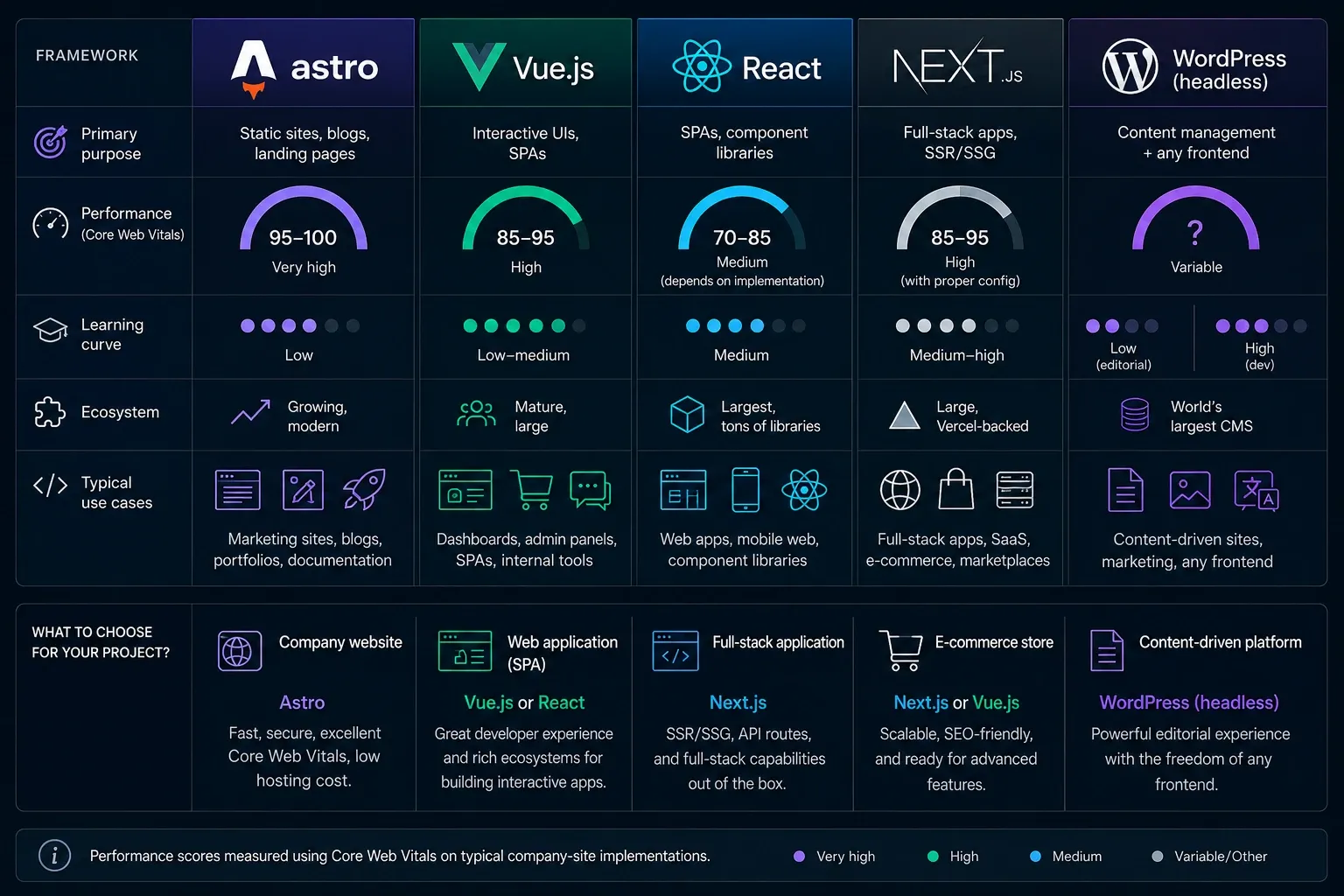
| Framework | Primary purpose | Performance | Learning curve | Ecosystem |
|---|---|---|---|---|
| Astro | Static sites, blogs, landing pages | Very high (95–100 PageSpeed) | Low | Growing, modern |
| Vue.js | Interactive UIs, SPAs | High | Low–medium | Mature, large |
| React | SPAs, component libraries | Medium (depends on implementation) | Medium | Largest, tons of libraries |
| Next.js | Full-stack apps, SSR/SSG | High (with proper config) | Medium–high | Large, Vercel-backed |
| WordPress (headless) | Content management + any frontend | Variable | Low (editorial), high (dev) | World’s largest CMS |
Performance scores measured using Core Web Vitals on typical company-site implementations. For what Next.js looks like in a shipped side project — including the Cloudflare Workers constraints — see how I built a recipe-archiving PWA with AI.
Astro — when SEO and speed are the priority
Astro is a static site generator with a “zero JavaScript by default” philosophy. Pages are generated as pure HTML at build time, and JavaScript loads only where it is actually needed (the “islands architecture” pattern).
When to pick Astro:
- Company websites, business cards, portfolios
- Blogs and content-heavy sites
- Campaign landing pages
- Technical documentation
Typical results: Astro sites regularly score 95–100 on PageSpeed Insights without additional optimization. Load times under 1 second are standard.
Limitations: Astro is not a framework for web applications with login and state. If the user has to perform complex operations, you need a separate backend (Laravel, Node.js) or a combination of Astro + Vue/React for interactive sections.
New in 2026: In January 2026, Cloudflare acquired the Astro team, and in April they released Emdash — an open-source CMS built on Astro 6 + Cloudflare Workers + D1, positioned as a modern WordPress alternative. Plugin isolation in V8 sandboxes, a built-in Model Context Protocol server for direct LLM integration, scale-to-zero edge computing. Still at v0.1.0 — early stage, with no mature ecosystem yet — but it signals where headless CMS is heading.
Vue.js — interactive UIs with a gentle learning curve
Vue 3 is a framework for building interactive user interfaces. It is simpler to learn than React, has excellent documentation, and a clearly separated syntax (template + script + style in a single .vue file).
When to pick Vue:
- Complex forms with validation
- Dashboards with charts and filters
- Product configurators, calculators
- Interactive islands inside Astro (my preferred combination)
Vue’s strengths in 2026: reactivity based on the Proxy API, Composition API, first-class TypeScript. The ecosystem (Vuex → Pinia, Vue Router, Nuxt) is mature and stable.
Limitations: smaller developer base than React. For large enterprise projects, React often wins because of greater specialist availability on the market.
React — the standard pick for SPAs
React remains the most popular JavaScript framework — according to State of JS, roughly 80% of front-end developers use it. That is its biggest advantage: availability of libraries, developers, and educational material.
When to pick React:
- Large enterprise applications (where team availability is critical)
- Hybrid mobile applications via React Native
- Projects that need to integrate with existing React infrastructure
React’s strengths in 2026: Server Components, ecosystem (Redux Toolkit, TanStack Query, shadcn/ui), React Native for mobile.
Limitations: more complexity than Vue, more architectural decisions left to the developer. It is easy to write a slow React app through inattentive re-rendering of components — squeezing out maximum performance requires experience.
Next.js — full-stack React with SSR/SSG
Next.js is a framework built on top of React, adding: file-based routing, server-side rendering (SSR), static site generation (SSG), API routes, image optimization. In 2026, it dominates production React applications — often treated as “default React.”
When to pick Next.js:
- SaaS applications (dashboard + landing + marketing in one repo)
- E-commerce with dynamic state (cart, checkout, account)
- Content-heavy platforms with personalization logic
- Projects that need to grow from MVP to a full product
Next.js’s strengths in 2026: App Router with Server Components, Turbopack (fast bundler), native Vercel integration. For applications that need SEO + business logic, this is often the best option.
Limitations: steeper learning curve than “vanilla” React. Hosting costs can be significant (server functions). Alternatives: SvelteKit, Nuxt (for Vue), Remix.
WordPress as a headless CMS — a bridge between old and new
WordPress is the most popular CMS in the world (about 43% of all websites on the internet). In headless mode, it serves as a content editor while the frontend is built in Astro, Vue, or Next.js — pulling data via REST API or GraphQL.
When to pick headless WordPress:
- The client requires a familiar editorial panel
- The editorial team is used to WordPress
- Many content changes per day (newsroom, company blog)
- Migrating away from classic WordPress without losing the workflow
Strengths: separation of content from presentation. The editorial team edits in a familiar panel, the site loads blazingly fast (because the frontend is static HTML + selective hydration). That is how Modern Car Blog works — one of my projects.
Limitations: two systems to maintain (CMS + frontend) instead of one. If the editorial team does not need WordPress, Markdown + Git is simpler (like this blog).
A WordPress alternative worth watching in 2026: Cloudflare Emdash — a young (v0.1.0, April 2026) open-source CMS built on Astro + Cloudflare Workers + D1. Combines the benefits of a headless CMS with native AI integration (Model Context Protocol), V8-sandboxed plugin security, and Portable Text content format (JSON instead of HTML — better for LLM indexing). For technical teams it’s a comfortable direction for the coming years — though for now it lacks the visual editors and mature ecosystem that WordPress offers.
Performance benchmark (typical implementations)
| Framework | LCP (mobile) | JavaScript transferred | Hosting cost |
|---|---|---|---|
| Astro (static) | 0.8–1.5 s | 20–80 KB | €0–2/month (CDN) |
| Vue (SPA) | 1.5–3.0 s | 100–300 KB | €2–5/month |
| React (SPA) | 1.8–3.5 s | 150–400 KB | €2–6/month |
| Next.js (SSR) | 1.2–2.5 s | 80–250 KB | €12–120/month (serverless) |
| WordPress + plugins | 4–10 s | 500 KB – 2 MB | €8–50/month (VPS) |
Estimates for comparable company-site implementations. Detailed benchmark methodologies are available on web.dev and in HTTP Archive reports.
When to pick which framework — 6 scenarios
1. Company website / business card with a blog → Astro (+ optionally Vue for interactive sections)
2. Google Ads / Meta campaign landing page → Astro (static HTML = fastest load = higher Quality Score)
3. Online store with cart and checkout → Next.js (application state + SEO + payment integrations)
4. Customer dashboard (CRM, analytics) → Vue or React (SPA with login, client-side state)
5. Company blog with an editorial team → Headless WordPress + Astro (frontend) — the editorial team has the familiar panel, the site is blazing fast
6. SaaS application (startup, MVP aiming to grow) → Next.js + Tailwind + Prisma (full-stack, easy to expand)
My practice — why Astro + Vue for most projects
Most of the company sites I build are a combination of Astro (static frontend) + Vue 3 (interactive islands) + UnoCSS (styles). Reasons:
- Unbeatable performance: 95–100 PageSpeed, sub-1 s LCP — these are not marketing claims but a measurable standard.
- Low maintenance cost: a static site on a CDN does not need security updates, plugin patches, or database backups.
- No WordPress = no typical security holes and no admin-panel spam.
- Easy to extend: if the client later needs a dashboard or a web application, I add Laravel/Filament as a headless backend — Astro wires it in through a REST API.
For application-oriented projects (with login, state, external integrations), I use Laravel + Filament as the backend and Vue 3 for the frontend. I recommend Next.js to clients who want a large enterprise-style team or are migrating from existing React infrastructure.
Not sure which framework fits your project? Get in touch with a description of what you want to build and I will recommend a concrete tech stack. Free call, no strings attached.