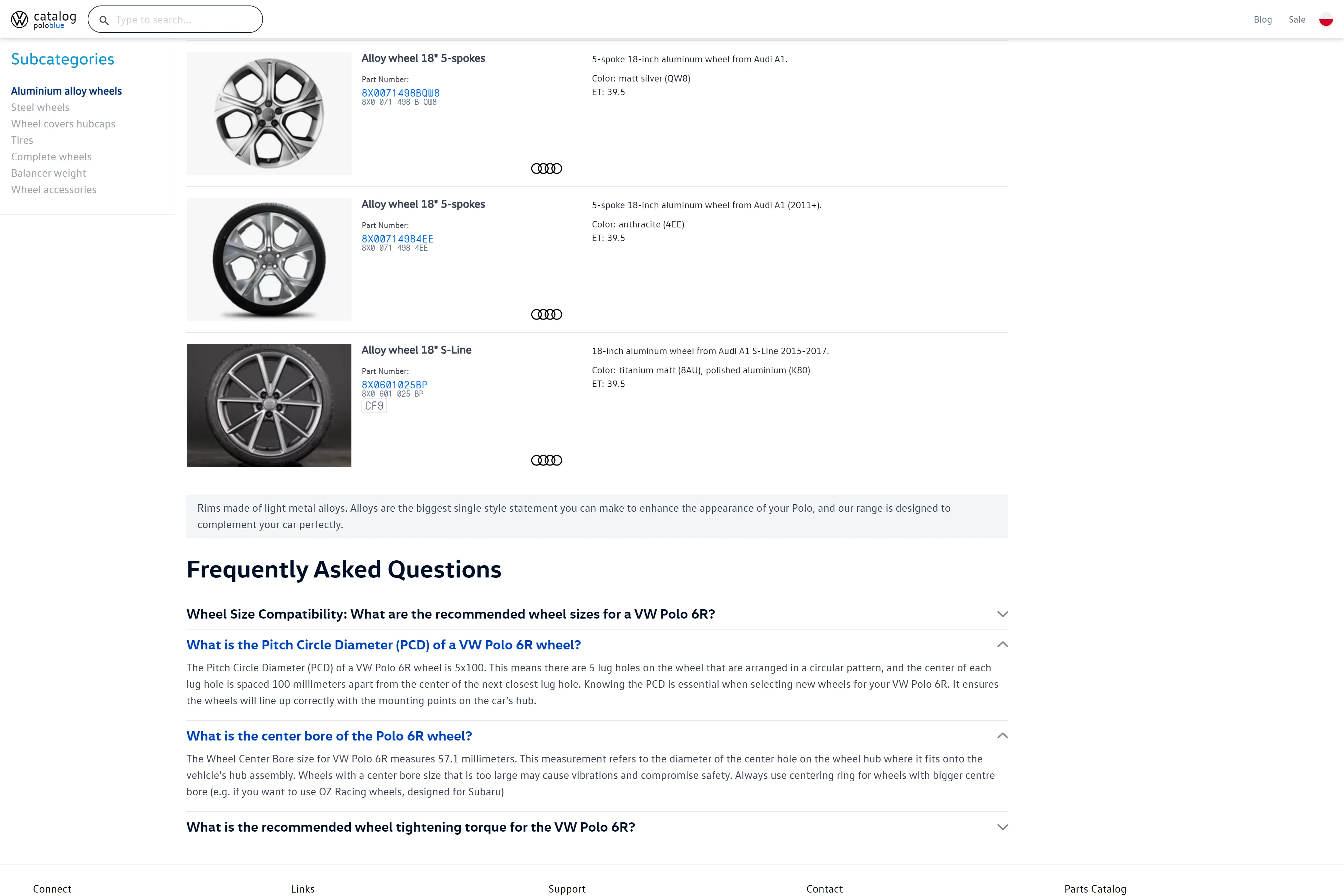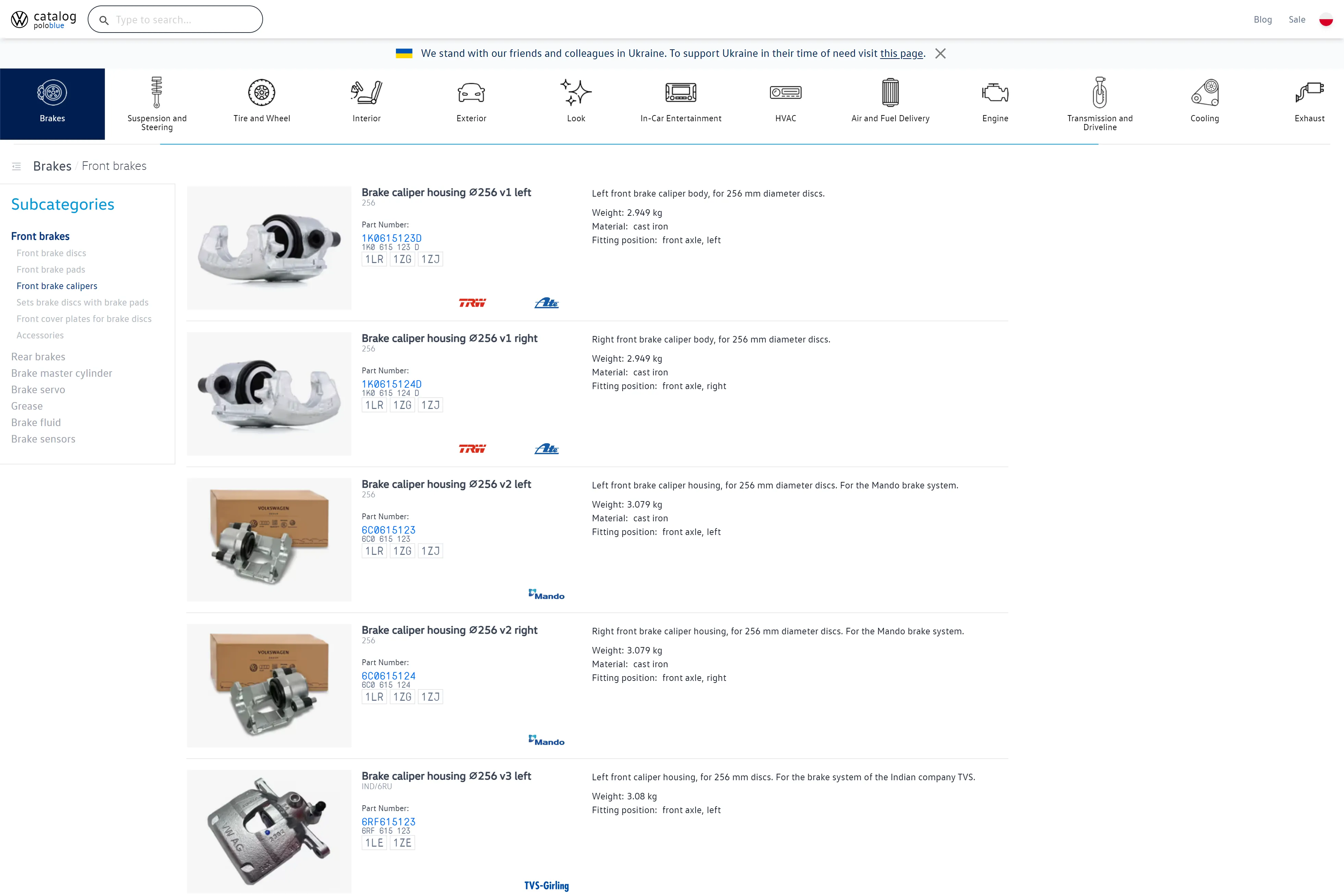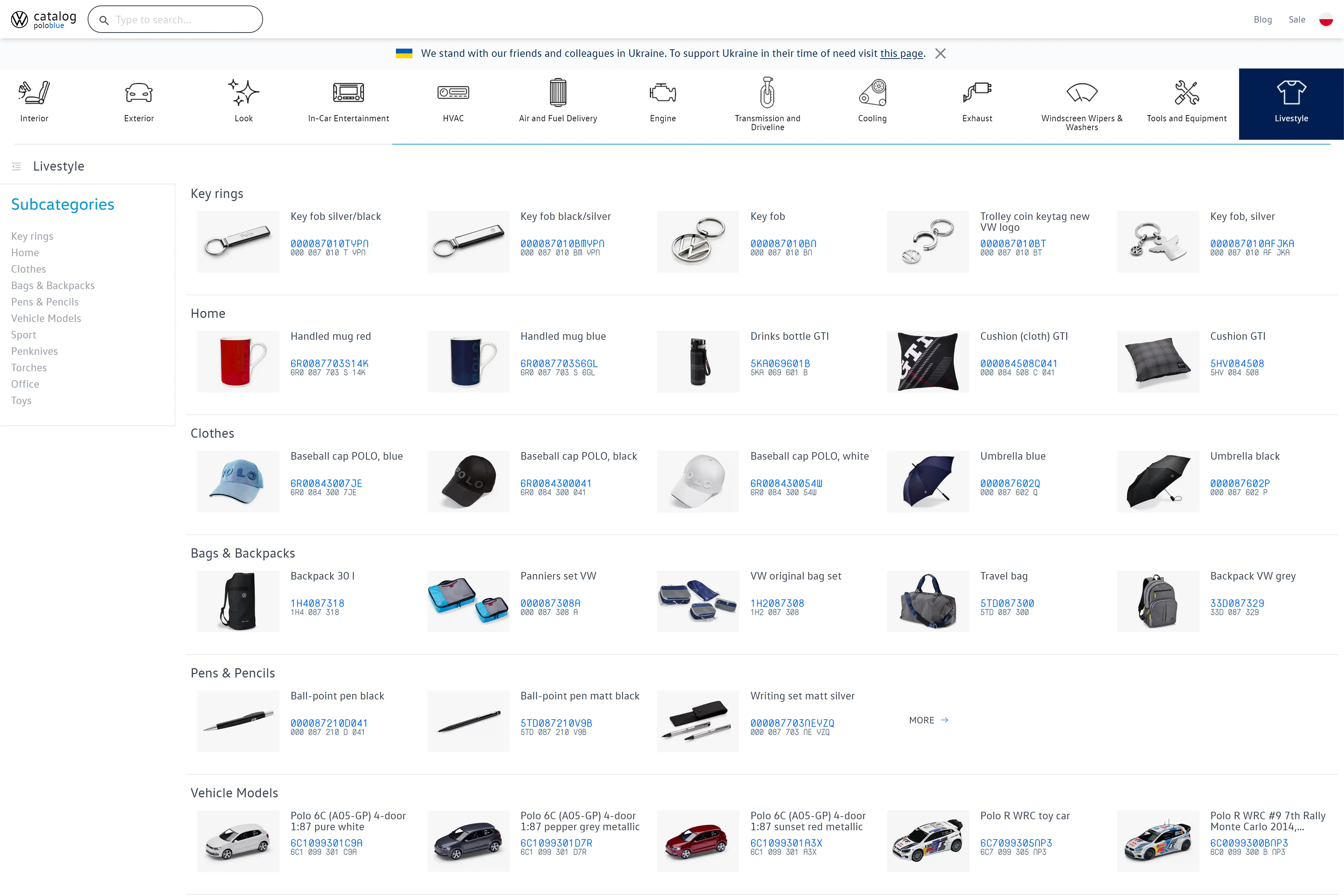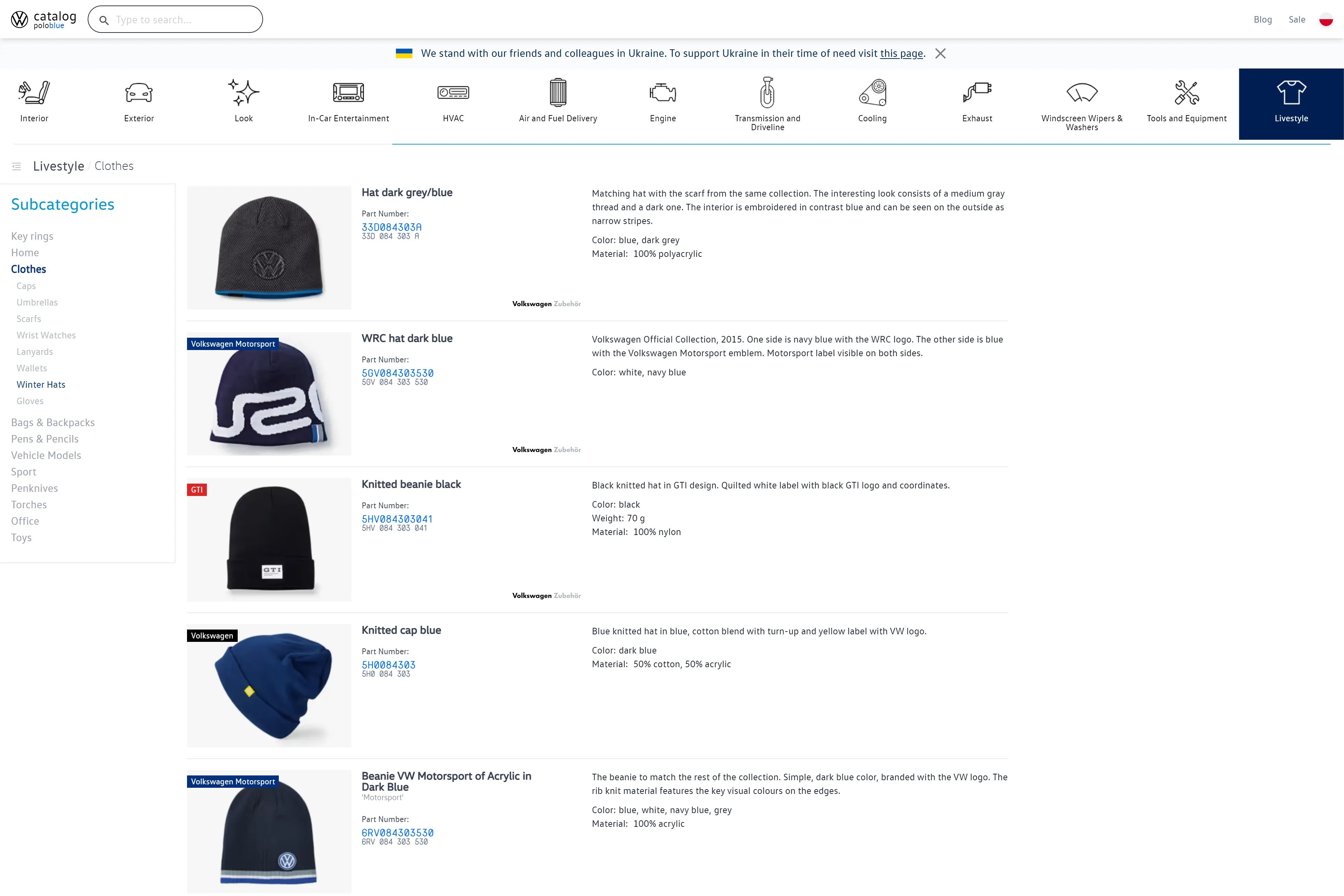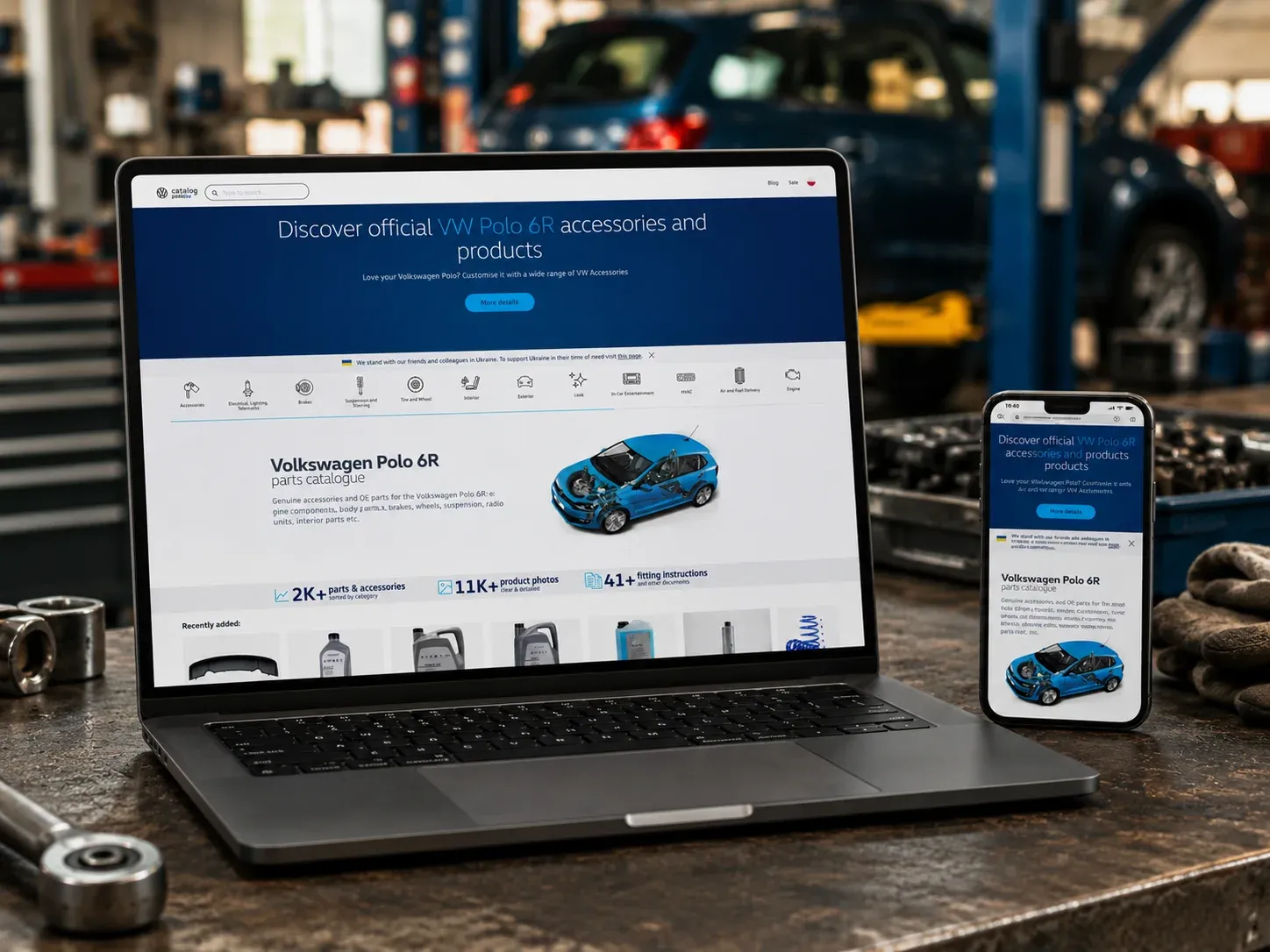
This catalogue of parts and accessories for the Volkswagen Polo 6R, which I run at catalog.polo.blue, has 2,200+ items in 22 categories, 13,000+ photos and 80+ manuals and documents, in English, Polish and German. It lists original (OE) parts only, with no aftermarket replacements. It is made for Polo 6R owners and hobbyists who are looking for a specific part: something broke, they are changing brake pads, springs or filters, or they want to add an accessory. I designed it, built it and run it end to end: the site, the admin panel with the data, and the translations.
At a glance
How people find a part
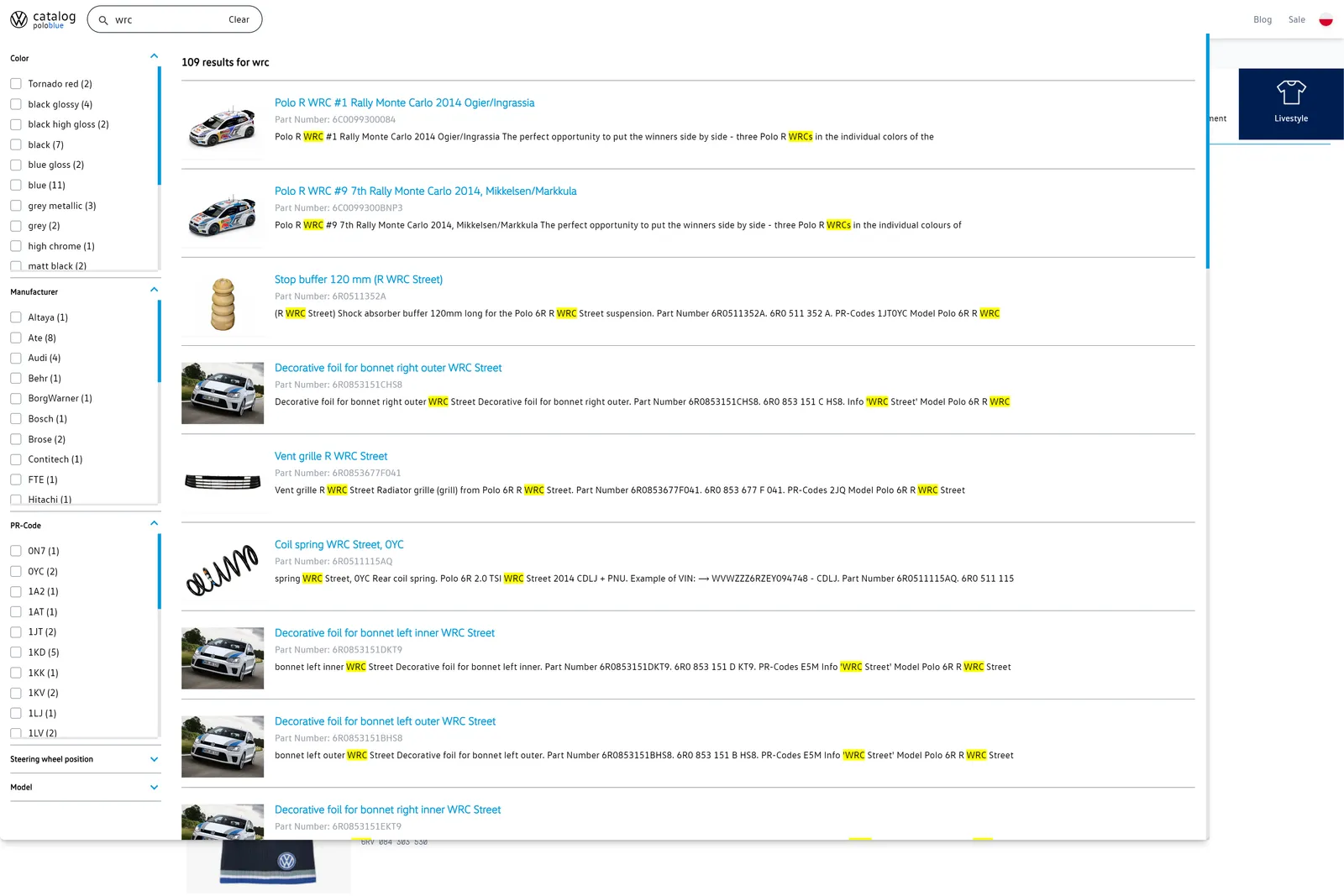
Someone replacing pads or a clutch usually has one piece of information: a number from the box, an invoice or a forum post. They type it their own way, with spaces, dots or dashes, and search finds it. Someone who does not know the number browses by category. There are 22, for example “Brake system”, split into front brakes, rear brakes, master cylinder and servo. You can also type just the part name.
The part page
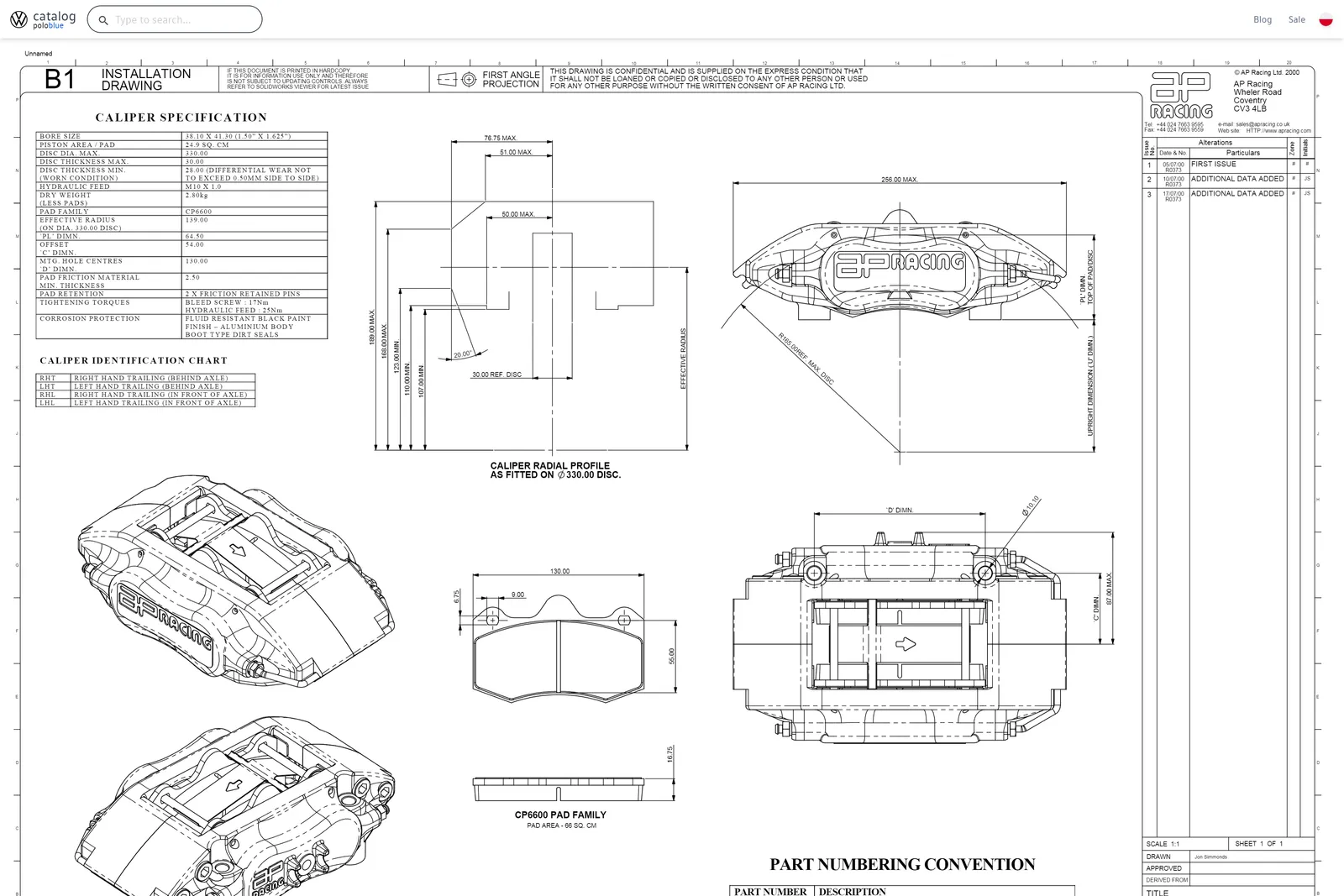
A part page holds what you need to check before ordering. Taking the front brake disc 6R0615301C as an example:
- the part number and its earlier and later numbers,
- PR code, fitting position, diameter, thickness, bolt pattern and weight,
- the type-approval document (ABE) where one exists,
- related parts: pads, disc shield, caliper,
- other variants of the same part, here discs of 288, 310 and 312 mm.
Some categories, such as wheels, also have a short FAQ with technical data.

Useful tools
Two small tools help choose a part before ordering it. The PR code decoder reads the three-character factory equipment codes from the sticker in the service book, for example 1KD is rear brake discs. Its database holds 14,288 codes for cars of the whole VAG group, and the descriptions are in English. The tyre and wheel calculator compares two setups: the difference in diameter and the speedometer error.

How I manage the data
A catalogue is only as good as its data. I run all of it from one admin panel:
- Products: number, name, specification, PR codes, manufacturers, engine fitment and photos. Categories form a tree with icons and images.
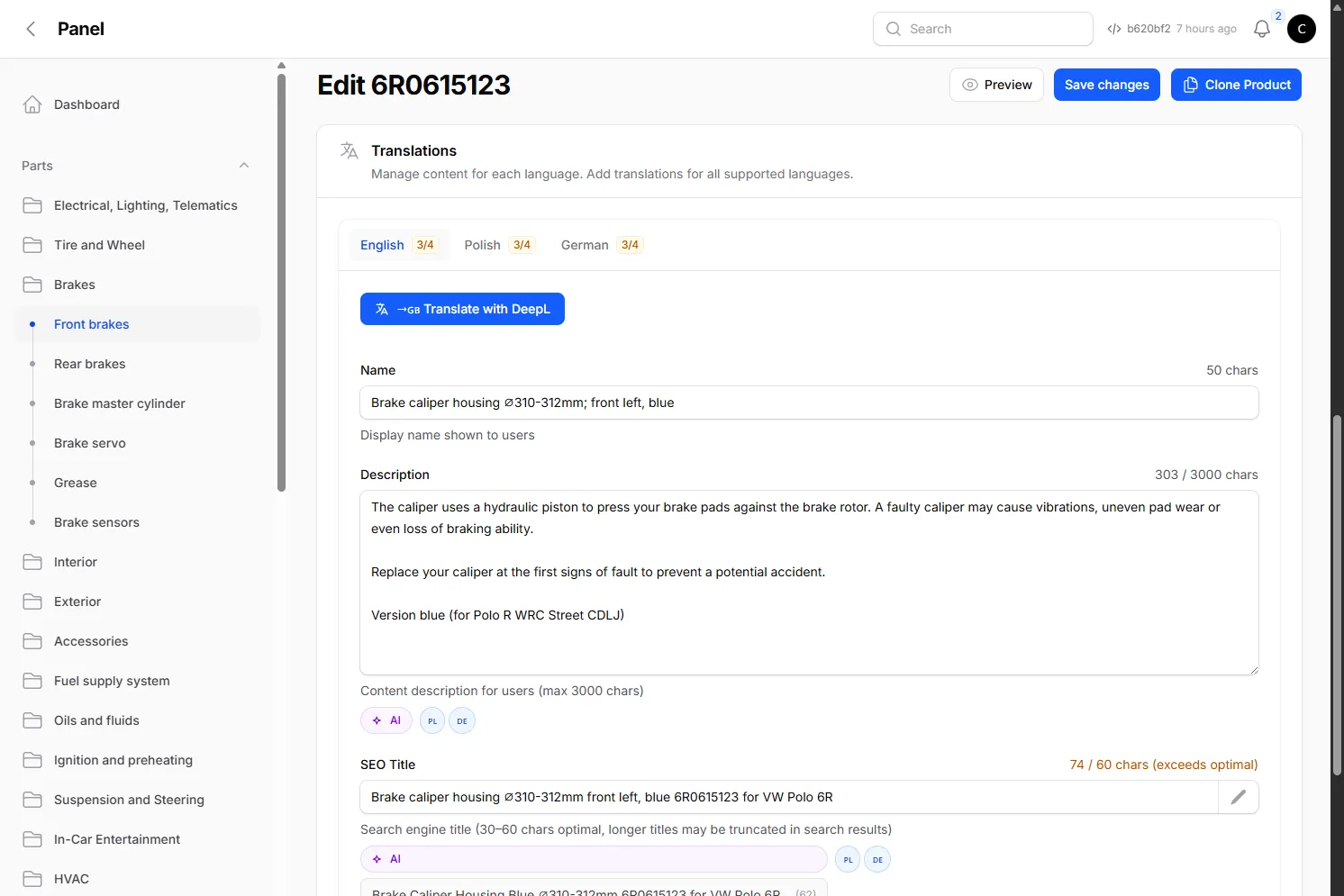
- Translations: I write the content in English. Polish and German are produced by DeepL in the background, and AI helps draft the part descriptions, which I then edit and approve. A translated field can be locked so the next translation run does not overwrite it.
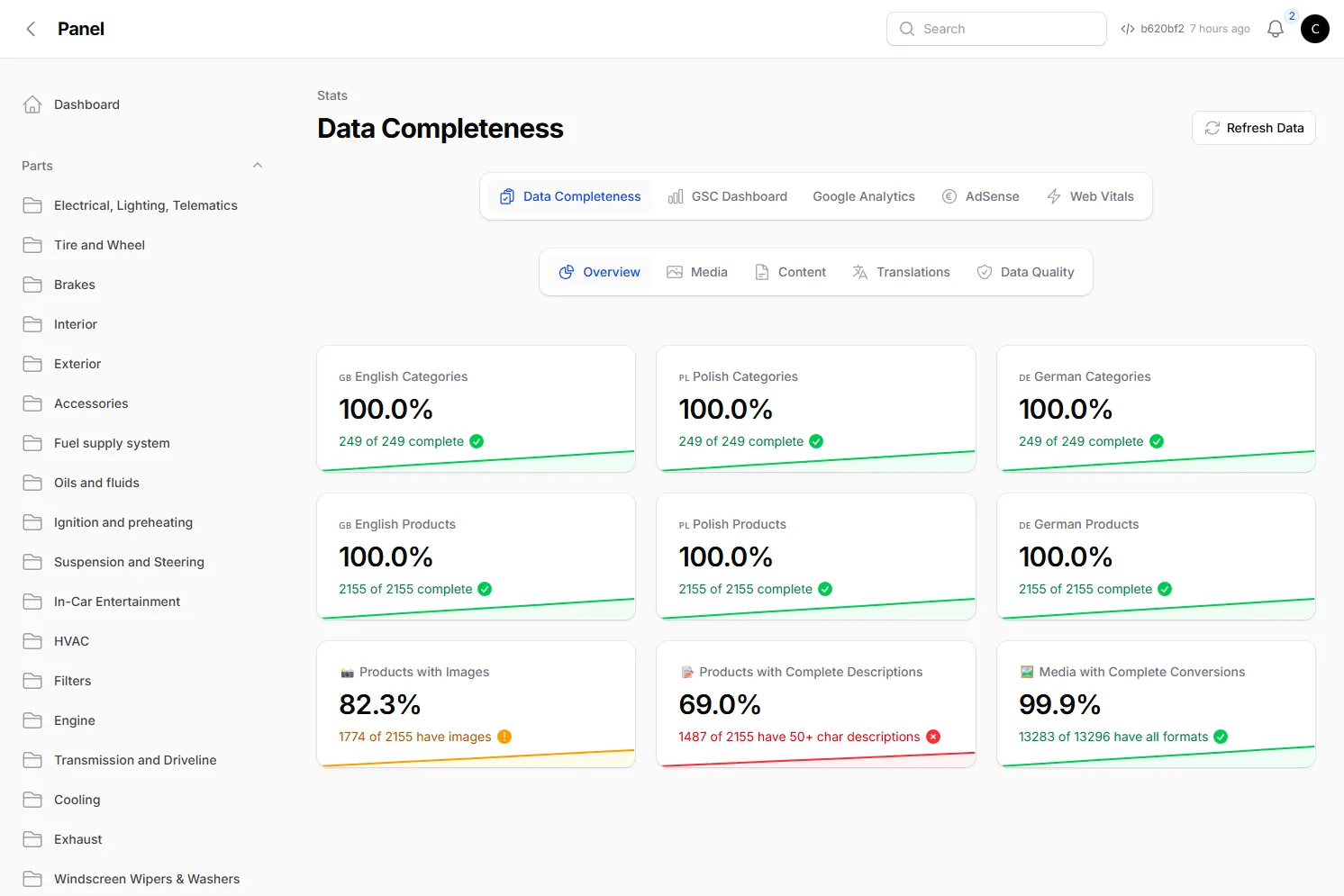
- Completeness: a separate dashboard shows which products lack a photo, a description or a translation in some language, and which SEO titles are too short or too long.
- Deployment: I publish a new version of the site with one click. Earlier releases are listed and can be restored.
Enquiries about parts
Listings on sale.polo.blue, a sister site with parts for sale, have an enquiry form. Messages land in the same panel as conversations, with the related product, internal notes and a status (replied, pending, closed).
Results
These figures measure traffic, not sales. Sources are Google Search Console and Bing Webmaster Tools, as of 8 October 2026.
- Search Console: 43.8K clicks and 1.36M impressions over six months, average position 7.3. Most clicks came from Poland (7.3K) and Germany (6.4K), then the United Kingdom and South Africa (3.7K each). About 62% of clicks came from phones.
- Bing: over six months, Copilot and Microsoft partners cited the catalogue as a source of answers 11.2K times.


Implementation
The site is static: every page is built ahead of time and the browser never queries a database. For a catalogue whose data changes less often than visitors arrive, that is the fastest and safest option. The panel and the API run separately, so nothing that happens in the panel slows the site down.
Astro and Vue 3
Astro generates plain HTML and Vue 3 loads only where something is interactive: galleries, tools, filters. I split the build by language version.
Laravel and Filament
Laravel serves the API and Filament provides the panel where I manage products, translations and deployments. Background jobs (images, translations, builds) go through queues, so the panel never waits for them.
Cloudflare R2 and CDN
Photos are converted to AVIF and WebP in several sizes and served from a CDN. Most traffic is on phones, so image weight decides how fast the site feels.
Pagefind
A full-text search built together with the site, separately for each language, with no external service.
Structured data and llms.txt
Every part has JSON-LD structured data (schema.org), sitemaps and hreflang tags for three languages. An llms.txt file helps AI models find the content. About 1.6K sessions came from AI assistants in the last 28 days (Google Analytics 4).
Related work
A catalogue with search and an admin panel for your own data is one of the projects I take on as part of web development. The Polo 6R blog that sits next to the catalogue is in its own case study, and the design system shared by both sites in the Spoko Design System article.