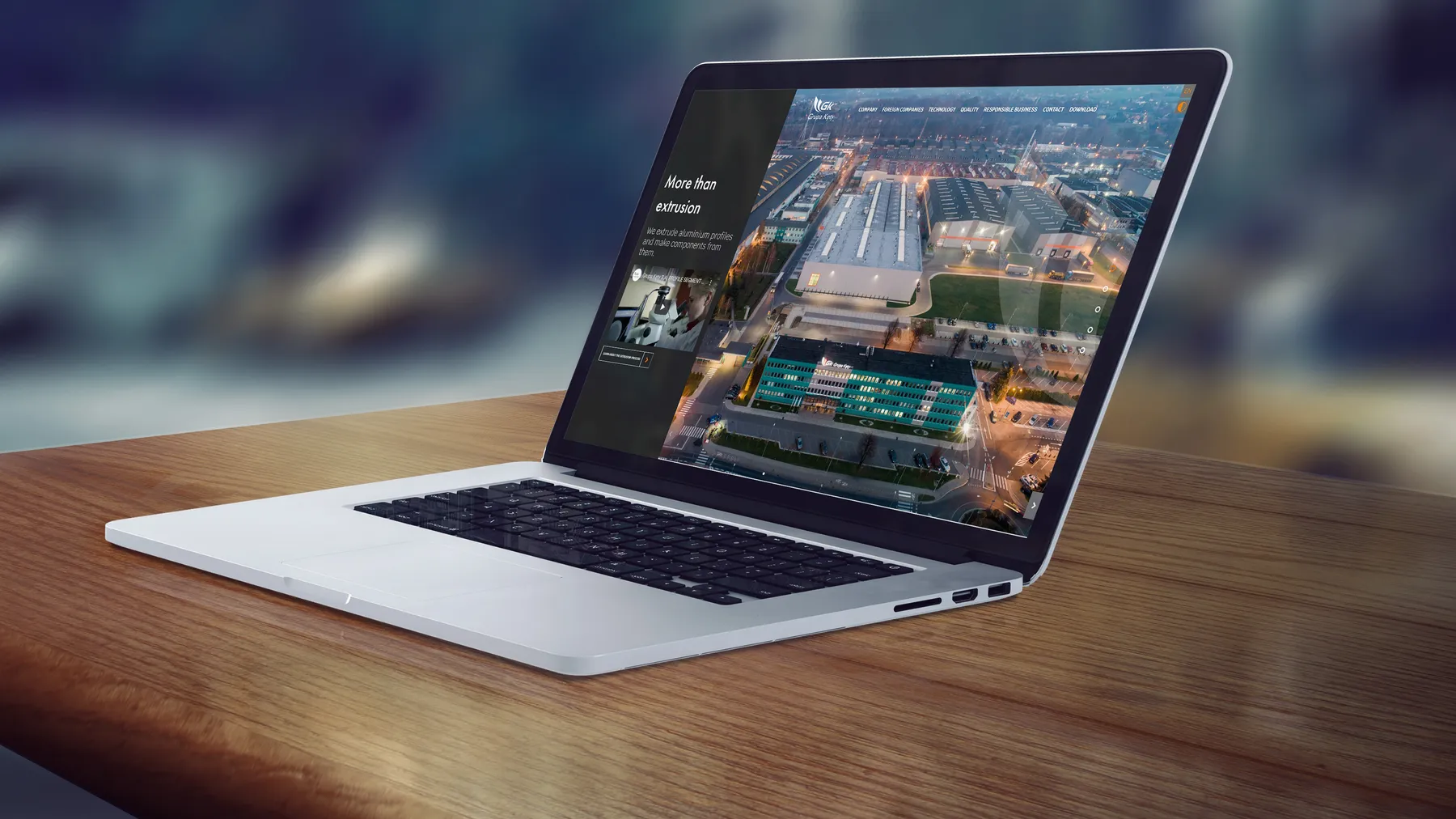
Project Overview
Profile.GrupaKety.com is a multilingual corporate website designed to serve a global audience in Polish, English, and German. The project was developed while I was working at Lizard Media Software House and involved building the site on the WordPress platform, following a detailed graphic design provided by the client. The goal was to create a visually consistent and user-friendly website that would effectively communicate the brand’s message across different languages while offering easy content management for the client.
Multilingual Implementation with Polylang
Given the international scope of the Grupa Kęty brand, the site supports three languages: Polish, English, and German. Translations are handled by Polylang — a plugin that treats each language version as a separate post/page linked by a translation relationship, rather than duplicating content inside a single entity. In practice this means the editorial team creates separate entries for PL/EN/DE and links them in the admin panel — the trade-off is more organizational discipline in exchange for no structural constraints between languages (e.g., the German version can carry different sections than the Polish one if marketing decides so).
I also added dedicated translation-status views to the admin panel — editors can see at a glance which entry already has all three versions and which is still missing a language. Support for hreflang and separate XML sitemaps per language comes from Polylang without extra configuration. The site’s content, images, and other media were managed to ensure accurate, culturally appropriate translations across all three markets.
Custom WordPress Development
The website was built on WordPress, chosen for its flexibility and user-friendly content management capabilities. However, to meet the specific needs of the client, I customized the WordPress administration panel. This involved tailoring the back-end interface to ensure that the client could easily edit and update all content without requiring technical expertise. The customization included intuitive controls for managing multilingual content, making it simple for the client to maintain the site in all three languages.
Custom CSS and Design Implementation
The front-end of the website was developed using custom CSS to faithfully replicate the provided graphic design. The design was meticulously implemented to ensure that the visual elements aligned perfectly with the client’s branding and aesthetic requirements. Custom CSS allowed for precise control over the layout, typography, and responsiveness, ensuring that the website looked and performed well on all devices, from desktops to smartphones.
Industry context
Grupa Kęty is one of Europe’s largest producers of aluminum profiles — components used in architecture, automotive, rail transport, and industrial automation. The Extruded Products Segment serves customers from all over Europe, which is why the offering needed to be presented in three languages (Polish, English, German).
A corporate website in this industry has a different function than a typical online store — its job is to educate technical decision-makers (architects, designers, engineers) about the capabilities and specifications of the profiles. Content is technically dense, often containing parameter tables, drawings, and PDF documentation — the site architecture had to handle all of this without compromising performance.
Scope of work
- Full layout implementation from the graphic design (desktop, tablet, mobile).
- Custom content types for product and service categories specific to the industry.
- A tailored admin panel — the editorial team manages trilingual content without technical expertise.
- Responsive handling of technical tables and product specifications on mobile devices.
- Technical SEO: hreflang,
Organizationschema, XML sitemap for all three language versions. - Integration with the Grupa Kęty brand-book system — consistent typography, color palette, and graphic elements.
Outcomes
The client received a professional, multilingual corporate site accessible to international markets — with a custom editorial panel that lets them update content independently without involving a developer. Visual consistency with the Grupa Kęty brand identity was preserved across every language version.
Retrospective: would I build this on WordPress today?
From today’s perspective (2026), no — although it’s worth giving credit to the context of the time. WordPress was the standard whenever you needed to put up a site quickly with an easy-to-use admin panel — for a non-technical editorial team the choice was essentially obvious. Realistic alternatives were scarce: apart from PyroCMS and a handful of similar niche platforms, a custom solution required a full team — a front-end developer, a back-end developer, and a graphic designer. Cost and delivery time were multiples higher, so for a corporate showcase site WordPress was a rational choice even knowing its long-term maintenance burden.
In 2026 the economics have shifted fundamentally. Thanks to AI, a single person can deliver a showcase-style site faster and better than the agency of that era — there’s no longer a need to engage a full software house for this kind of project, which significantly lowers the cost threshold. A custom build is no longer a luxury reserved for large budgets, and its technical advantages come to the front:
- Maintenance. Standard WordPress requires continuous care — core, plugin, theme, and PHP updates. Any of them can break production, and skipping them leaves an open door for attackers. A custom panel without a sprawling plugin ecosystem has a significantly smaller surface of change.
- Security. WordPress as a platform is the most common target of automated attacks on the web — every outdated plugin is a potential entry point. Custom solutions are not in the constant rotation of CVE scanners, which materially reduces risk in practice.
- Frontend stack. The project used vanilla JS + jQuery — the standard in 2019, but jQuery is no longer used in modern sites. Current builds I ship on Astro with Vue/React islands, applied only where interactivity is actually required — the rest stays as static HTML.
When does WordPress still make sense? For editorial teams that already know the admin panel and publish large volumes of short content quickly. For a corporate product catalog in 2026, I would pick an architecture based on a static site generator + a headless CMS instead — fewer moving parts, fewer updates, faster loading, none of the issues from the three points above.
Conclusion
The development of Profile.GrupaKety.com was a successful collaboration that resulted in a polished, multilingual corporate website. By leveraging WordPress’s capabilities and customizing the CMS to suit the client’s needs, I was able to deliver a platform that is not only visually appealing but also easy for the client to manage. The use of custom CSS ensured that the design was implemented accurately, reflecting the brand’s identity across different languages and regions. This project highlights the importance of adaptability and attention to detail in creating a website that effectively serves a global audience.