Astro is a web framework that renders pages to HTML at build time and ships no JavaScript unless a component asks for it. Interactive pieces are declared one by one as islands, so a page carries the code for those and nothing else.
What it is
A framework for building sites whose default output is HTML. You write components — in Astro’s own syntax, or in Vue, React, Svelte — and by default they run once, during the build, and leave markup behind. A component only reaches the browser as JavaScript if you explicitly ask, one component at a time.
That inversion is the whole product. Most frameworks ship an application and render content inside it; Astro ships content and admits an application where you point at it.
Why it matters if you are paying for a website
Because the bill for a site is usually paid in JavaScript that nobody needed. A brochure site built as a single-page application downloads a framework in order to display three paragraphs; the same site in Astro downloads the three paragraphs.
For anything whose job is to be read and found — a company site, a blog, a catalogue, a landing page — that is the right default, and it is why this site is built this way.
What it looks like here
This site is Astro, so the claims above are ones I have to live with. Every page is prerendered; the handful of interactive things — the menu, the theme toggle, the image lightbox, the consent banner — are islands with their own small scripts. An article carries none.
The cost side is honest too. A content change means a rebuild, and this build takes a few minutes, because it also renders a social card per page in a headless browser and then runs its own checks over the output: links, structured data, title lengths, the Markdown mirrors, the language pairs. That is a good trade at a hundred pages and a bad one at a hundred thousand.
When it is the wrong choice
When the thing you are building is an application rather than a document. A dashboard where every panel shares state, a tool with a live-updating table, anything behind a login where most of the screen is interactive — those want a framework designed for a running application, and reaching for islands there means fighting the model. That work goes to Vue and Laravel in my hands, not to Astro.
What Astro is not
It is not a CMS — nobody edits content in it — and it is not a backend. It builds pages from whatever source you give it: files in the repository, a headless CMS, an API. What it replaces is the theme layer, not the database.
Related terms
See also
Want this done, not just defined?
This is the part of the work I get hired for. The page below says what it costs and how it runs.
Web developmentWhere I write about this
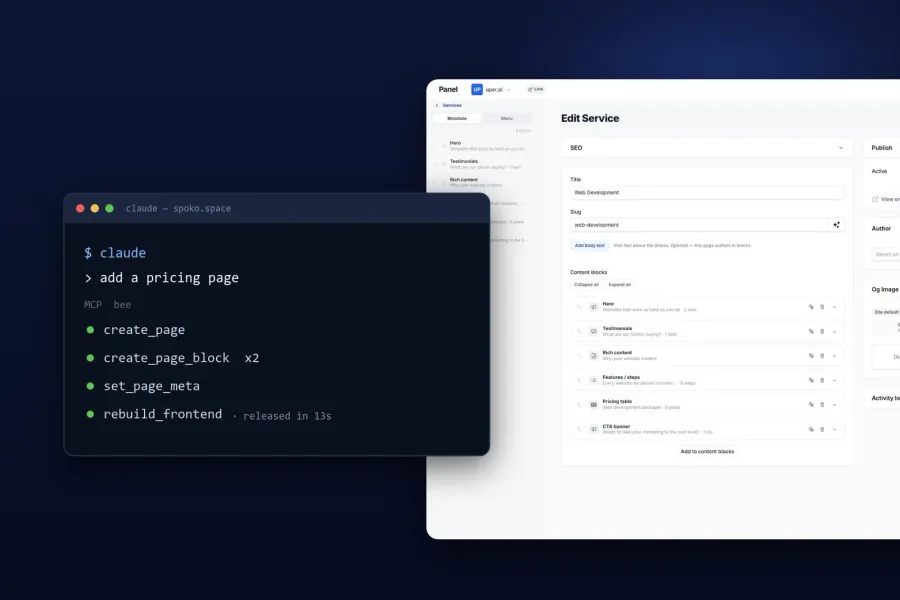
Custom CMS with AI
A custom headless CMS and content dashboard for managing websites, pages, translations and media from a single interface — with AI connected to the content workflow over MCP.

Modern Car Blog
An automotive blog on headless WordPress and Astro, ready to work with AI over MCP.

E2E Testing with AI and Playwright (2026) — Practical Guide
Where AI actually saves time in Playwright E2E tests: selector strategy, prompt patterns, MCP integration, and real ROI numbers from production projects.

How to Choose the Right Web Developer
Check the portfolio, ask about technologies, read the reviews — but there are a few things that separate a good developer from a bad one. A practical guide for business owners.
Web Application Frameworks in 2026
Astro, Vue, React, Next.js or headless WordPress? A practical comparison of the popular frameworks with performance benchmarks and usage scenarios.